What Men Should Wear on Video Calls: Collars and Textures That Still Show Up on Camera
Published
Five minutes before the meeting, you switch on your camera to check your hair. In the small window in the corner of the screen, the finely checked shirt that looked so neat in the mirror this morning is now flickering. It looks like a TV channel with bad reception. You'd change, but your boss has already joined the call.
A laptop camera doesn't see the way your eyes do. It only captures your head and the top of your chest, then sends what it sees as a small image that has lost quality by the time it arrives. Fine detail vanishes, or worse, becomes a distraction. What stays clear on other people's screens is the shape of your collar, the texture of the fabric and a colour that stands out from the wall behind you.
People See Your Collar Most, So Make Sure It Holds Its Shape
Your collar sits right below your face, so whenever people watch you talk, they see your collar too. Curled collar points, or one side that has flopped down, make you look as if you've just rolled out of bed, however good the shirt is.
A button-down collar, with a small button at each point, is the easiest to keep tidy, because the points stay pinned in place. This light blue oxford shirt is one example, made from mid-weight cotton that's thick enough to hold a crisp shape. A polo works too, as long as the collar hasn't gone limp and its points haven't started to roll. If you leave the top button undone, check that both sides of the collar sit evenly before the camera comes on.
Textured Fabric Is Safer on Camera Than Thin Stripes and Small Checks
Thin, closely spaced stripes and small checks are the patterns most likely to flicker on camera. Their lines clash with the camera's pixel grid, and the result is a ripple that moves every time you shift in your seat. Even a tiny logo on your chest shrinks to a dot.
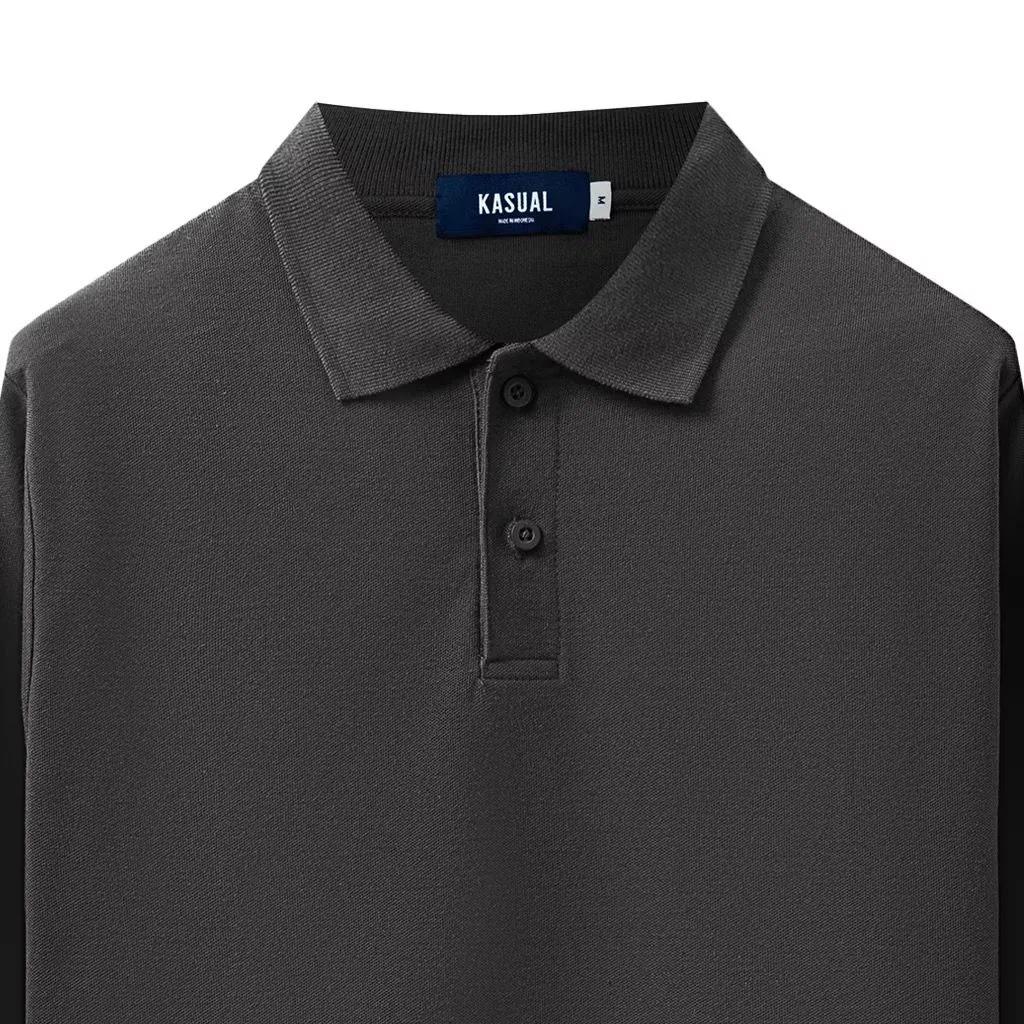
Fabric texture is a different story. An oxford weave, which gives cotton a slightly grainy surface, doesn't form hard lines. Nor does the piqué knit on a polo, whose surface is dotted with tiny holes like a honeycomb. The camera doesn't pick out those details one by one. On screen, the result is a solid colour that still has some depth and doesn't turn shiny under the lights.
For a more relaxed office, the long-sleeve Rise Polo in dark grey uses that kind of knit, and its long sleeves make it look closer to a shirt on screen.
Pick a Shirt Colour That Stands Out From the Wall Behind You
Your trousers don't make it into the frame, so the contrast that matters most is between your shirt and the wall behind you.
White or cream walls, the most common kind in homes and rented rooms, work well with light blue or anything darker. If you sit in front of a dark bookshelf or deep-coloured curtains, go the other way. A cream oxford shirt makes your shoulders stand out clearly from the background.
Pure white and jet black are the trickiest. A white shirt can make the camera turn the brightness down, so your face goes darker too. Jet black swallows detail: the collar and its folds disappear, leaving just a dark shape. If you like dark colours, navy and dark grey are usually kinder to the camera.
Test Your Video Call Outfit on the Laptop Camera, Not in the Mirror
A mirror can't show you what the camera sees. Before an important meeting, turn your camera on in the same spot and under the same light you'll have during the call. Straighten your collar while looking at the screen, then shift slightly to the left and right. If any part of your shirt flickers or your shoulders blend into the wall, change now, while nobody is waiting for you yet.
Frequently Asked Questions
Is a plain T-shirt okay for a video call?
Yes, for relaxed internal meetings, as long as the neckline hasn't stretched out and the colour is different from your wall. For client meetings, a shirt or polo looks more put-together.
Does a batik shirt work for video meetings?
Yes, especially one with a large motif that isn't too tightly packed. A small motif repeated close together can flicker just like small checks, so test the shirt on camera first.
What's safer to wear for a video job interview, a shirt or a polo?
A shirt with a neat collar is safer, especially if you don't know the company's culture yet. A polo is better suited to routine meetings with your own team.
If I'm short on time, which parts of my shirt really need ironing?
The collar, shoulders and upper chest, because that's all the camera picks up. The lower half of the shirt is usually hidden behind the desk.
Do I need smart trousers if the camera only shows me from the chest up?
Just wear something presentable. Every now and then you'll have to stand up to grab something or adjust your laptop, and the camera stays on while you do.