
At twenty to seven, your phone pings. Your motorbike taxi is already waiting at the end of the lane. On the bed lie two shirts you've given up on. One hasn't been ironed. The other only goes with a pair of trousers still sitting in the laundry basket. Your wardrobe is full, and yet this morning it feels as if there's nothing to wear.
The advice you'll hear most often for this problem is to clear out half your wardrobe and keep only black, white and grey. That can help, but it misses where the trouble actually starts. A minimalist wardrobe that genuinely feels effortless is one that boils each morning down to a single small decision. How many clothes it holds, and in which colours, is a question for later.
Why You Can't Decide What to Wear: Clothes That Only Go With One Thing
The clothes you give up on most often tend to have something in common: each one only works with one or two other things in your wardrobe. A shirt with a loud print that only looks right next to black trousers. Brightly coloured trousers that will only get along with a white T-shirt.
Clothes like these always come with extra questions. Has its partner been washed? Has it been ironed? If the partner is still on the drying rack, this one can't be worn either. So a wardrobe packed to bursting can still produce only a handful of outfits that are ready to wear.
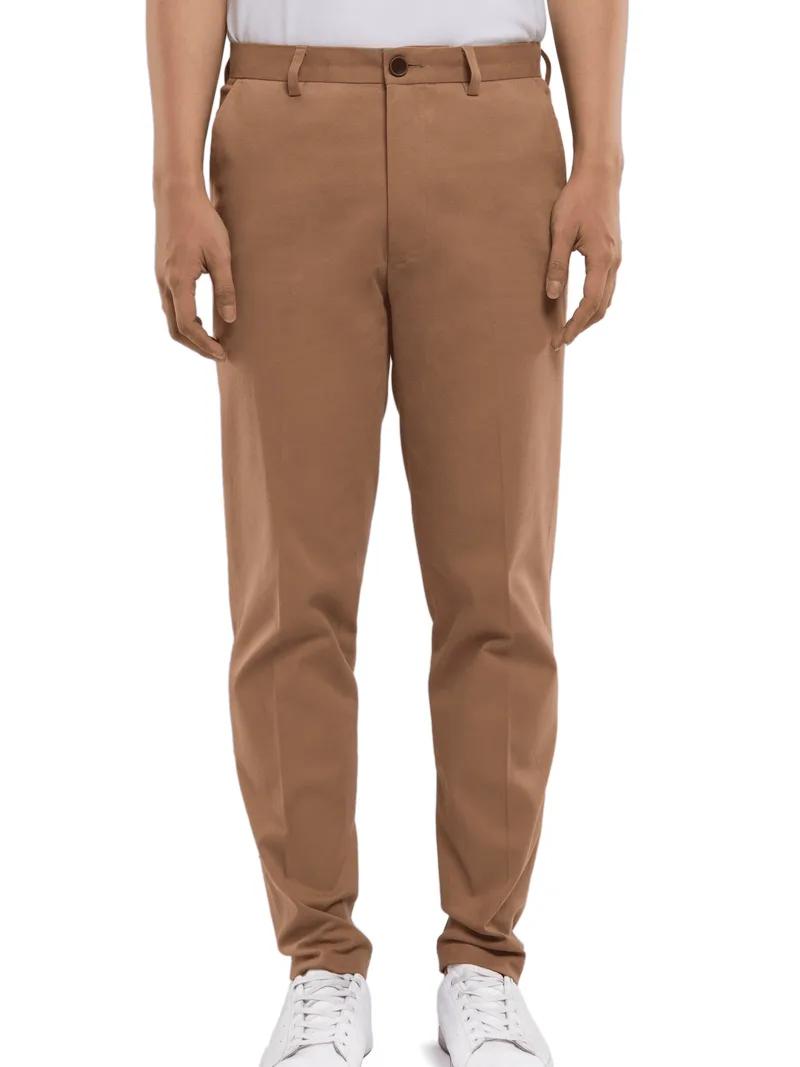
The opposite is clothing that never asks anything of you, like a plain shirt in a muted colour. Or a pair of chinos in brown or grey, cut from cotton with a fine diagonal weave. Both get along with almost everything else you own, so you can reach for them without thinking.
A Minimalist Wardrobe Isn't About Numbers or Neutrals
Advice on capsule wardrobes, small collections of clothes that all go together, often comes with exact numbers. This many tops, that many pairs of trousers. Some go further and allow neutral colours only.
Those numbers know nothing about your days. Someone who meets clients every day needs more shirts. Someone whose work keeps them out on site needs more T-shirts to change into. Mornings feel easy when your pieces can swap partners freely, however many of them you own.
The same goes for colour. Trousers or shirts beyond the neutrals can still earn a place, as long as they get along with most of your wardrobe. Olive green chinos, for instance, still look right with a white or navy shirt.
There's an easy test for this. Grab a top and a pair of trousers without looking, as if you were still half asleep. If what you end up with is fit to wear out of the house, your wardrobe passes.
Set Your Daily Outfit Formula Once, Then Repeat It
A formula here just means the kind of combination you keep coming back to. Some people call it a personal uniform. On workdays, for example, it's always a shirt and chinos. On weekends, it's always a T-shirt and more casual trousers. If you usually wear a koko shirt for Friday prayers or family occasions, that counts as a formula of its own.
With a formula, the morning question changes. You stop asking what to wear. You just pick the colours, and because they all go together already, that choice is almost impossible to get wrong.
Monday is a white oxford shirt with coffee brown chinos. Tuesday is a light blue shirt with dark grey chinos. The look changes, but it's still only one decision. Shoes follow the same rule. One pair of white sneakers and one pair of brown leather shoes will usually cover every one of those formulas.
Your colleagues won't count how many times you wear a blue shirt in a month. They'll remember just one thing: you always look smart.
A Wardrobe Rotation: Take From the Left, Return to the Right
If even choosing a colour still feels like too much, let the order decide. Take your shirt from the far left of the rail. Once it's been washed, hang it back on the far right. Every piece gets its turn, and you don't have to choose at all. Folded T-shirts and trousers can work the same way: whatever has just been washed goes to the bottom of the pile.
The system doubles as a check. Notice which clothes you skip when their turn comes around. If you pass over the same shirt twice in a row, there's bound to be a reason. Maybe it has nothing to pair with. Or maybe the fabric is too warm for your commute. If the reason can be fixed, fix it. If not, it may be time for that shirt to move into someone else's wardrobe.
Ironing and a Tight Waistband Are Morning Decisions Too
Morning decisions aren't only about what goes with what. There are smaller questions as well: whether you have time to iron, and which trousers won't feel tight if there's a group lunch later. Clothes that are fussy on either count quietly lengthen your list of decisions.
On days that call for a neat look, choose fabrics that don't crease easily. The black Superfine Koko shirt, for example, is made from a blend of polyester and modal that resists wrinkles and dries quickly. After washing, it only needs a quick press. It has a mandarin collar, short and upright, so there are no collar points to curl.
For trousers, the dark grey Smart Waist chinos have hidden elastic inside the waistband. You still have room after a meal, and one more morning question disappears.
Before You Buy, Check It Works With Your Formula
The system only holds up if new pieces follow its rules. Before you buy something, name three things in your wardrobe you could wear it with. If you can't, chances are it will join the pile of rejects on the bed.
This rule doesn't ban the things you love. A patterned jacket that makes you happy every time you see it can still have its place. Think of it as an occasional guest, while your daily formula is made up of the pieces that get along most easily.
Tomorrow morning, when the driver messages to say they're at the end of the lane, all you have to do is reach for the shirt on the far left.