
In almost every man's wardrobe there's one t-shirt with a history of demotion. It used to be the first pick every time he left the house. Now it only gets worn at home, or when every other tee is waiting in the laundry queue.
There's no clear moment when it happens. No tear, no stubborn stain. The shirt just slowly changes shape, until one day you catch your reflection and realize it no longer looks sharp.
The good news: a tee almost never goes sloppy overnight. It gives in little by little at specific points, and those points can be read, whether the shirt is still on a store hanger or has been living in your wardrobe for years.
A Tee Gives In at Specific Points, Not All at Once
T-shirt fabric is stretchy, and precisely because of that, its fatigue doesn't spread evenly. Three places work the hardest: the shoulder line, the collar, and the hem. Each has a different job, so each shows fatigue differently.
The shoulder line holds the overall shape. The collar frames your neck and face. The hem decides where the shirt ends on your body. If even one of these three starts to give in, the whole tee looks tired, even when the rest of it is still fine.
So judging a tee isn't about looking at it as a whole. It's about checking those three points one by one.
The Shoulder Line Is the First Benchmark
A correct shoulder seam lands right at the tip of your shoulder bone, running straight from the neck toward the arm. If the seam drops onto the arm, the tee looks borrowed. If it climbs too far toward the neck, the tee looks tight and pulls at the armpits.
There is an exception. Oversized tees deliberately drop the shoulder line, and that's design, not a flaw. The problem starts when a tee that's supposed to fit begins imitating the oversized look after a few washes.
The sign is easy to spot: the shoulder seam is no longer straight but curved, either from hanging too long on a small hanger or from being weakly sewn from the start. In the store, lift the tee and look at the shoulder seam up close. A seam that's flat and straight from day one usually lasts longer.
The Collar Admits Defeat First
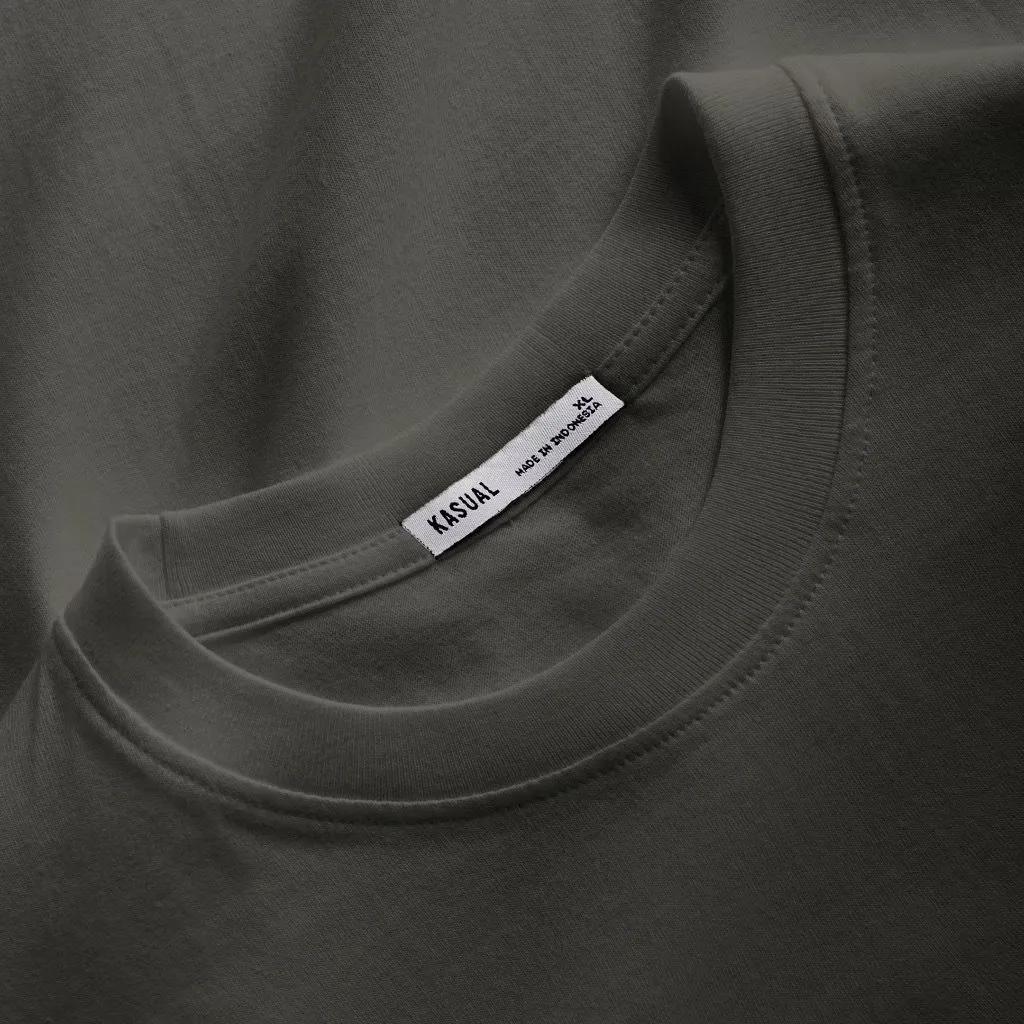
Of all the parts, the collar usually shows its age first. The fabric around your neck gets pulled every day as you put the tee on and take it off, gets wrung during washing, then is expected to lie flat again like nothing happened.
A healthy collar has recovery. Pull it gently with two fingers, release, and it returns to shape. A weak collar stays stretched, and soon after, its edge starts rippling like a cracker that's caught moisture.
Once the collar ripples, no iron can truly save it. The neck looks loose, and the whole tee reads as worn out even if the body is still smooth. That's why, when choosing a tee, the collar deserves your first test.
The Hem Decides Your Body's Proportions
A well-placed hem stops around the middle of your trouser fly. Long enough not to ride up when you raise your arms, but not so long that it covers that entire area. Too long and your legs look short. Too short and your stomach shows every time your arms go up, like a leftover school tee you never got around to replacing.
This position can shift. Some tees shrink upward after washing; others stretch downward as the fabric tires. The sign is easy to see: the hem curves up on one side, or rolls even after ironing.
Look at the side seams too. On a tee whose fabric is starting to tire, these seams slowly twist toward the front. If it's already twisting in the store, after a few washes it will twist even further.
There's one quick test: fold the tee in half lengthwise and check whether both sides meet neatly from shoulder to hem. If anything is slanted or longer on one side, the fabric is no longer symmetrical.
Color also affects how quickly this fatigue shows. Dark tees, like the navy Crew Navy Blue Tee, are more patient at hiding creases and small fading than white tees. That doesn't mean they last forever, but they usually look sharp for longer.
Checking a Tee with Your Hands Before Paying
On a store hanger, every tee looks fine. Gravity works for the seller: fabric pulls downward, folds fall neatly, the collar sits politely. That's why you judge a tee with your hands, not your eyes.
First, squeeze the fabric for a few seconds, then let go. Fabric that's thick and dense enough will settle back into a calm drape. Thin, loose fabric stays crumpled as if it's still being squeezed. Second, gently pull the collar and release it, like the recovery test earlier. Third, feel the shoulder seam with your fingers. A dense, even seam feels different from a thin, rippled one.
If you need a reference point, start with a line that focuses on crew neck tees, like the Crew Tee collection from KASUAL. Hold the collar and seams, memorize how they feel, then compare them with other tees you're considering. After two or three tries, your hands start telling the difference without much thought.
Signs a Tee Is Due for Demotion
There comes a time when a tee can no longer be saved, and admitting it actually makes your wardrobe healthier. The signs are simple: the collar stays rippled even after proper washing and ironing, the shoulder seam is permanently curved, the side seams twist, the hem rolls, or the color fades unevenly at the neck and armpits.
Demotion doesn't mean throwing it away. A former favorite tee still earns its place as a house shirt, a sleep shirt, or a workout companion. What matters is that it stops taking up a slot meant for going-out tees.
One small honesty needs saying. However good a tee is, some occasions call for more structure than jersey fabric can give. When an invitation or an appointment demands a more put-together impression, let a black oxford shirt take over the job. Even your best tee deserves a rest.
A tee that stays sharp isn't the expensive one. It's the one whose three lines are still in place: shoulders straight, collar springing back, hem calm. That's the kind of tee you can pull from the wardrobe half-asleep, wear out of the house, and never once stop in front of a mirror.