
You're standing in front of your wardrobe, and nearly every pair of trousers in it is black. Safe? Sure. But look closer: in bright rooms or in photos, black often reads flat. The color absorbs light until the creases and fabric texture disappear, and all that's left is a dark surface with no detail.
There are four other colors that are actually easier to wear day to day. And each one fills a different role in your wardrobe.
Navy: Sharp Without Feeling Stiff
Navy has a depth of color that nearly matches black, but the fabric still shows its shape. Creases stay visible, stitching reads clearly. It pairs well with white, grey, dark green, and almost every shirt color you already own. If you can only add one pair of trousers beyond black, this is the one: navy trousers in an ankle cut that stops just above the ankle, for example, work for the office or a night out without needing a change.
Grey: The Color That Never Clashes
It's hard to find a top color that doesn't go with grey. But one thing is worth noting: mid grey is more versatile than dark grey. Dark grey instantly reads formal, while mid grey is still comfortable for a Saturday coffee run after a Friday at the office. Silver-grey trousers with a Smart Waist elastic waistband are made for exactly that kind of double duty.
Khaki: Gives a Plain Top Real Character
Khaki works hardest when your top is simple. A white shirt that normally feels unremarkable suddenly looks like a deliberate choice the moment it meets khaki. Pair it with navy or dark green tops too, a combination that almost never misses.
Cream: The One You Buy Last
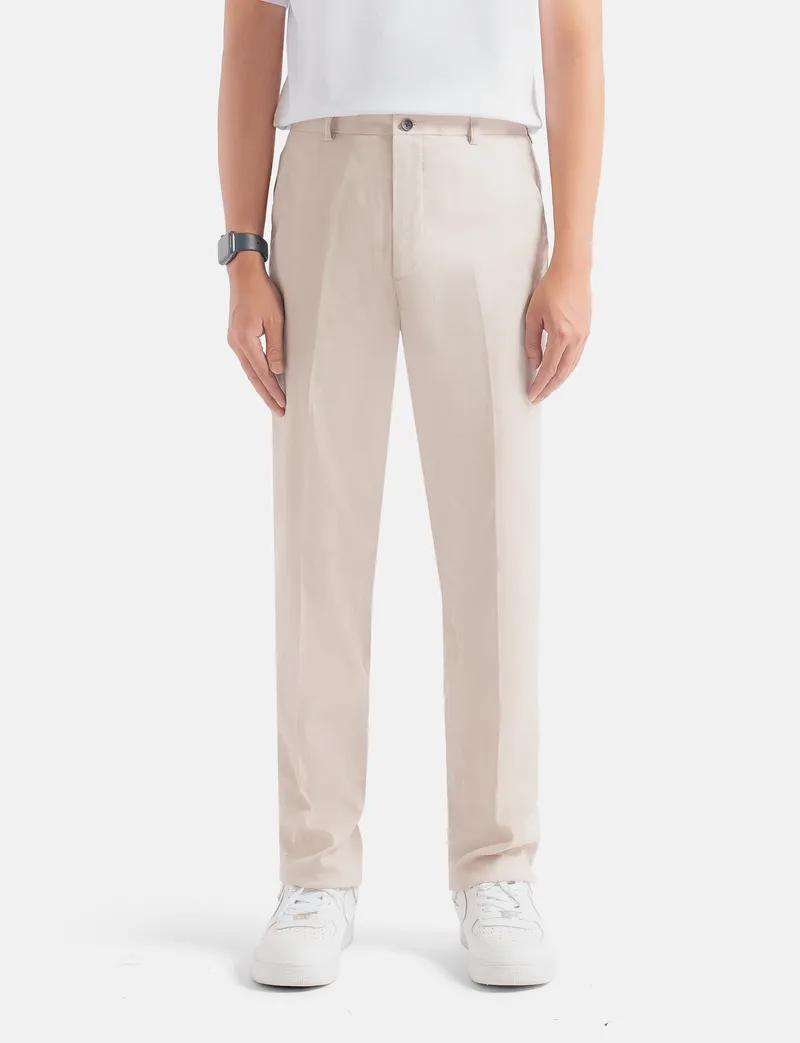
Cream is the lightest color on this list, and yes, the most eye-catching. But it's also the fussiest to maintain. If you ride a motorbike every day or spend a lot of time outdoors, cream needs washing more often than the other colors. So the order makes sense: complete your navy, grey, and khaki first. Once those three are covered, then add cream trousers in a gurkha cut, a style with front pleats and a wide waistband as the finishing touch.
One Principle to Keep Color Pairings From Feeling Off
One thing to avoid: pairing two colors that are too similar. Navy with dark blue, or grey with a slightly different grey, usually looks like a mismatch, not an intentional pairing. Keep a clear distance between your top and bottom colors. A firm contrast always looks more deliberate than a half-hearted resemblance.
If you're starting from zero, here's the order: navy first, then grey, then khaki, and cream last. Those four colors cover almost every daily need, and your wardrobe no longer has to lean on black.
Frequently Asked Questions
Are black trousers still worth wearing?
Yes, especially for formal events or evenings out. But for daily wear, navy and grey have more life because the fabric's texture doesn't get swallowed by the color.
If I'm buying just one pair of trousers besides black, which color should I pick?
Navy. It's just as sharp as black, but far easier to pair with almost any top color.
Are khaki and cream the same thing or different?
Different. Khaki is darker and more brown-toned, so it holds up better for daily wear. Cream is much lighter and shows dirt faster.
Which is more versatile: dark grey or mid grey?
Mid grey. Dark grey tends to read formal, while mid grey is still comfortable for weekends and polished enough for the office.
What top color is safe with all four of these trouser colors?
White. It works with navy, grey, khaki, and cream without ever feeling wrong.
Is it okay to wear a top and trousers in nearly matching colors?
Better not to. Two colors that are almost the same but not quite usually look like a mistake. Keep a clear color gap between top and bottom.