
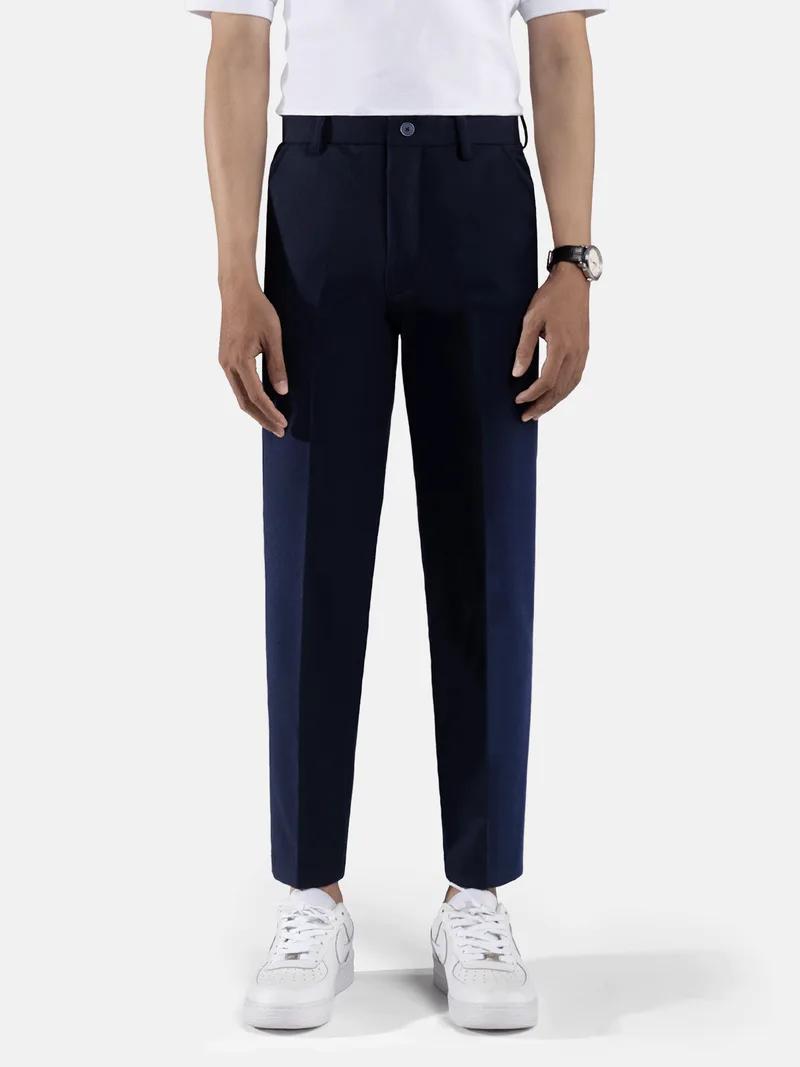
You've tried on three pairs of pants in the fitting room. All the same size. But one is tight at the thighs, one hangs loosely around the knees, and one feels right but looks flat. The problem isn't the size. It's the cut. Slim, skinny, and straight create room in different places. And what determines which one suits you isn't the trend, but the shape of your own legs.
If you're not sure how each cut differs, there's a quick explanation of what skinny, slim, athletic, and straight fit mean in the KASUAL Help Center.
If You Have Fuller Thighs
Go with straight or regular. Slim on fuller thighs will cling at one point and pull the fabric upward every time you sit, and you'll feel that all day, not just for five minutes in the fitting room.
Don't work around it by going up two sizes. The waistband becomes loose, the thighs stay tight, and you end up with pants that are wrong in two places at once. A cut that genuinely has more room in the thigh, like the khaki regular comfort pants, solves the problem at its source.
If You Have Slim Legs
Slim is the best match. Straight actually leaves empty space around the knees and calves, and that space makes your legs look shorter than they really are.
Skinny still makes sense if you genuinely like a tight silhouette, but pair it with slim, thin-soled shoes so the lower half doesn't look heavy.
If Your Legs Are Proportional
Straight is the safest choice. The line runs straight from thigh to hem without clinging or hanging excessively, so the pants look clean without much overthinking.
Slim can still work too, but straight gives a more relaxed impression without sacrificing neatness: ideal if you don't want your pants following your leg shape too closely.
If You're Under 170 cm Tall
Length matters more than cut. Pants that bunch up on top of your shoes make your legs look cut off, no matter how good the cut is at the thigh.
A hem that lands right at the ankle is enough to make your legs look longer, even on a cut that isn't tight. So before choosing between slim or straight, make sure the length is right first. Even wide pants with a clean silhouette can work, as long as the hem isn't dragging on the floor.
Rules That Apply to Every Cut
Whatever the cut, measure your thigh before buying. Here's how: wrap a measuring tape around the widest part of your thigh (usually about five centimeters below the crotch), then compare the number with the size chart. A waistband can still be adjusted by a tailor; a thigh can't. And if you're stuck between two sizes, go up one. Fabric that's slightly loose can still be taken in, but fabric that's too small can't be fixed.
If you want to start comparing right away, take a look at the KASUAL pants collection while keeping one question in mind: does this suit my legs, or does it just suit what's trending?
Frequently Asked Questions
What's the difference between slim fit and skinny fit?
Slim follows the shape of your legs with some room to spare, while skinny hugs tightly from thigh to ankle. The full explanation is in the KASUAL Help Center.
Can I still wear slim fit with bigger thighs?
You can try, but the fabric usually pulls when you sit. Straight or regular is far more comfortable and still looks sharp.
Is it okay to size up so my thighs fit?
Not recommended. The waistband ends up loose while the thighs stay tight. Better to change the cut, not the size.
What shoes go well with skinny fit?
Slim shoes with thin soles, like low-top sneakers or loafers. Thick soles make the lower half look heavy.
What cut should I wear if I'm under 170 cm tall?
Any cut works. What matters is that the hem falls right at the ankle. That alone is enough to make your legs look longer.
Which part of the pants is most important to measure before buying?
The thigh. A waistband can still be adjusted by a tailor; the thigh can't. Measure the widest part of your thigh, then compare it with the size chart.