
At your cousin's wedding, the photographer asks the front row to crouch down. You end up on the far left. That night the photo lands in the family WhatsApp group, and everything looks fine until your eyes drift down to your own trousers. The knees seem to have slid down onto your shins. The hems have ridden up so far that your socks are on show.
Yet the trousers seemed fine when you tried them on in the shop. The waist fitted and the length was right. There was only one difference: in the fitting room you stood up straight in front of a mirror, and at the wedding you crouched.
Why Knee Problems Don't Show When You Stand
Every pair of trousers has a knee line built into its pattern. It marks the height where the leg starts to narrow, and it's also where the fabric is meant to fold when your leg bends. That height is fixed when the pattern is drafted, long before the trousers ever meet your legs.
As long as you're standing, gravity pulls the fabric straight down. In that position, even trousers with the knee line in the wrong place can look perfectly fine.
Bend your legs and it's a different story. The fabric has to fold somewhere, and the pattern has already picked the spot. The fabric has no idea where your knee is. If the pattern's knee line happens to land right on your knee, the fold looks natural. If it doesn't, the fold turns up somewhere odd, and your leg looks as if it bends in the wrong place.
Signs the Knee Line Sits Too Low or Too High
That wedding photo shows a knee line sitting too low. This problem is easiest to catch when you sit down. The knee of the trousers drops towards your shin, while the fabric bunches up below your real knee. From the side, your leg looks like it has two bends.
When the knee line sits too high, what you feel instead is pulling. Every time you bend your leg, the fabric tightens above the knee until horizontal creases appear across your thigh. Your knee feels as though something is gripping it. Sometimes the sign shows up even while you're standing, as a small fold hanging loosely just above the knee.
These symptoms are often mistaken for trousers that are simply too small. To tell the two apart, notice when the pulling starts. If the fabric is already straining across your legs while you stand still, the size is most likely too tight. If the pulling or bunching only arrives once your legs move, the problem is where the knee line sits.
The right position is simple enough. The fold forms right at your knee joint, and when you sit, the knee of the trousers stays on your knee.
The Slimmer the Cut, the More a Misplaced Knee Line Shows
A slim cut follows the leg closely, so even a slightly misplaced knee line shows straight away. A straight cut is a little roomier at the knee, which gives the fabric space to fold. If the two terms still sound alike, there's a short explainer in our Help Centre.
In tailored trousers like the Ankle Classic in navy, the fabric falls cleanly along the line of the leg. That also makes it easy to see where the fold forms. As long as that fold stays at your knee while you move, the pattern genuinely suits your legs.
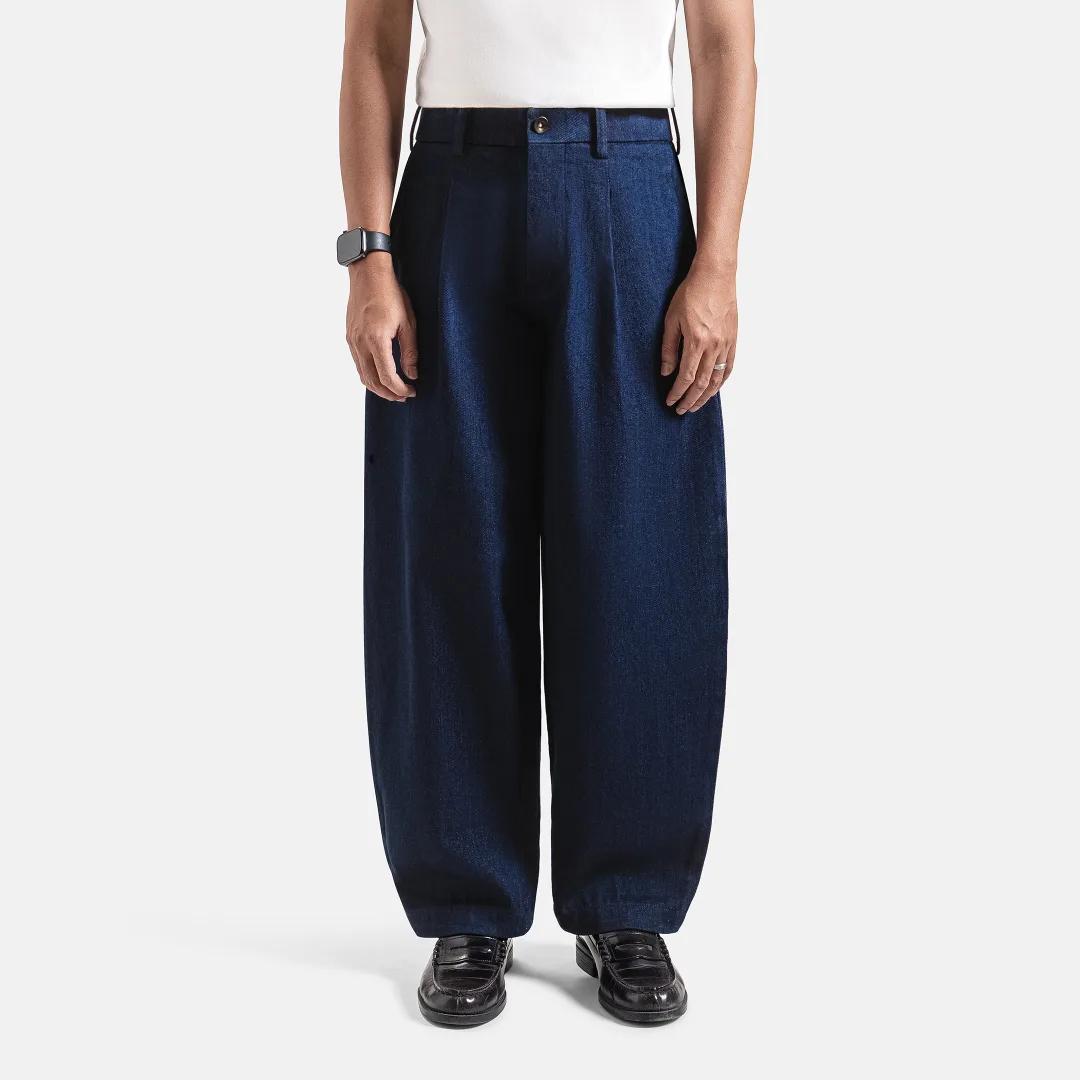
If the knee is where your trousers usually go wrong, a barrel cut is worth trying. It widens through the thigh and knee, then narrows again towards the ankle, much like the barrel it's named after. The looser fabric around the knee disguises a knee line that's slightly off. Take the Barrel Jeans in navy. Need something more office-friendly? The same cut also comes in a black version.
A wide cut, roomy from thigh to hem, hides the knee completely under fabric. Don't be too quick to call it the solution, though. Fabric that piles up at the bottom can form folds of its own, and those are just as distracting.
A Tailor Can't Move the Knee Line
A tailor can shorten your trousers by cutting them down at the hem. The trouble is that taking length off the bottom doesn't move the knee line at all. Moving the knee line means recutting the whole leg, and the result is rarely worth the cost.
So getting the hems taken up is still fine if length is all you need to change. When it comes to the knee, what you can change is the size or the cut you choose. A size with a longer leg usually brings the knee line down with it. Switching sizes sometimes does the trick, as long as the waist still fits.
What about knees that bag out after you've been sitting for a while? The fabric usually flattens out again if you hang the trousers up overnight. If the bagging stays, the fabric has stretched for good. Often the cause is a misplaced knee line, which means the same patch of fabric gets pulled over and over.
Simple Moves to Check the Knee Line in the Fitting Room
Because it's hard to fix later, this is a problem best caught in the fitting room. The key is to do more than stand there. Sit down on whatever bench is available, and see whether the knee of the trousers stays on your knee or slides down to your shin. Then drop into a half squat and feel where the fabric pulls. Pulling above the knee means the knee line is too high. Bunching below the knee means it's too low.
If there's a stair or a low platform nearby, step up onto it. The fold should form right at the joint. A pair that passes all of these moves has a knee line that matches your legs. If it fails any of them, try another size or a cut with more room at the knee.
The same test works when you shop online. Do it at home as soon as the parcel arrives, before the tags come off and before the hems go to a tailor.
One last check often gets skipped. Stand back from the mirror and take a photo of your reflection on your phone, once standing and once in a half squat. When you look down, you see your trousers from above, and from that angle almost any pair looks fine. The camera sees them from the front, just as the photographer at the wedding did.