
The photos from the office event have finally landed in the WhatsApp group. In one of them, you're shaking hands with the new director. Good smile, tidy collar. Then your eyes drop to that outstretched hand. Your shirt cuff has slid a long way up your forearm, and the wrist it usually covers is now competing for attention.
And yet that morning, the shirt looked fine in the mirror. The catch is that in front of a mirror, your arms stay still. Once you're out of the house, they almost never stop moving. They type all morning, then stretch to the far end of the lunch table for the sambal. It's movements like these that show a sleeve's real length.
With Your Arms at Rest, Shirt Sleeves Should End at the Wrist Bone
Start with the simplest position. Let your arms hang loosely at your sides. A cuff that fits stops right at the wrist bone, the small bump on the little-finger side. If the edge falls slightly over the back of your hand, that's still fine, as long as the fabric isn't bunching up.
The limits are easy to remember. If the sleeve swallows part of your hand, it's too long. If the whole wrist bone is on show while your arm is resting, it's too short.
But this position is only the starting point. Plenty of shirts pass at this stage, then fail once you start working in them.
Reach Out, Then Watch Where the Cuff Goes
A cuff always pulls back when you move, and the reason is simple. When your elbow bends, the sleeve fabric has to curve around it. When your arm reaches out, the fabric at the shoulder gets pulled along too. All that extra fabric is borrowed from the end of the sleeve.
So what you're really judging is how far it pulls back. Stretch your arms straight out in front, as if holding a steering wheel, then raise them as if reaching for something on a high shelf. After that, sit down and put your hands where they'd be for typing.
A sleeve of the right length rides up a little, then drops back on its own once your arms come down. That small retreat is actually a good sign. It means the shirt has fabric to spare for your reach.
A sleeve that's too short pulls back well past the wrist and makes itself at home there. You find yourself tugging the cuff down again and again between tasks. A sleeve that's too long causes trouble from the other direction. The fabric piles up at the wrist and gets in the way every time you flex your hand at the desk.
Sleeves Too Long Can Still Be Saved, Sleeves Too Short Can't
Sleeves that are too long are the easiest to spot. Your hands seem to drown in the shirt, and without realising it you push the sleeves up several times a day.
The good news is that this can be fixed. If the difference is small, move the cuff button over a little so the cuff closes tighter. A snugger cuff holds at the wrist and doesn't slip down over the back of your hand. A needle and thread will do, no tailor required. In casual settings, a single roll of the sleeve can disguise it too. If the difference is bigger, that's when you take it to a tailor. Having sleeves shortened usually costs very little.
Sleeves that are too short are more frustrating, because there's almost no remedy. You've already seen the main sign: the cuff rides up and settles in on your forearm. There's a second sign, too: a pulling feeling at the elbow every time your arm bends. Rolling the sleeves up to the elbow does hide the problem, but then the shirt only feels right rolled up.
This problem shows most on dark work shirts, like a black oxford shirt. The line between a black cuff and bare skin is stark, especially when your hands spend all day on a laptop. Even a centimetre or two is enough to catch the eye.
If you've already ended up with a shirt whose sleeves are too short, don't rush to get rid of it. Measure the sleeve and write the number down. That number is now your minimum: your next shirt has to be longer than that.
If you're torn between two lengths, go for the slightly longer one. You can take length off, but you can't add it back. Cotton shirts also tend to shrink a little in the first wash, so that small margin rarely goes to waste.
In the Fitting Room, Button the Cuffs Before You Move
Don't judge a shirt standing straight in front of the mirror. Once it's on, button the cuffs first. Cuffs left open slide down over the back of your hand and make the sleeves look longer than they really are.
Only then reach forward and up. Watch for just two things: how far the cuff pulls back, and whether it settles back into place without you tugging it. If the fitting room has a stool, sit for a moment and pretend to type on your lap. Nobody can see you, and it's better to find out here than from a photo in the office group chat.
Shopping From Home: Measure the Sleeve Length of Your Favourite Shirt
When you're shopping on your phone, there's no way to try the shirt on. Instead, take the old shirt whose sleeve length you like best. Lay it flat on the bed and straighten the sleeve. Measure from the shoulder seam to the end of the cuff. That number is more reliable than a guess, because the shirt has already passed the movement test day after day.
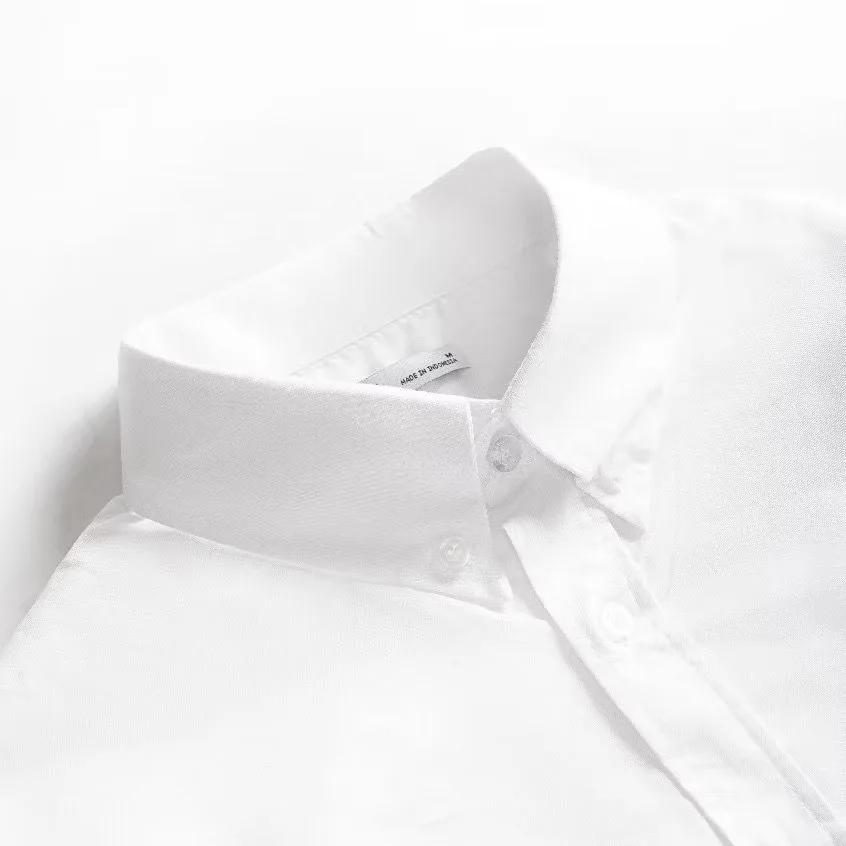
Compare it with the size chart on the product page. On the white oxford shirt page, for example, the chart lists the sleeve length for each size. Those figures are measured on the shirt, not on a body, so you're comparing shirt with shirt.
One more thing: going up a size doesn't always mean longer sleeves. On that chart, some neighbouring sizes have exactly the same sleeve length. If your arms are long, check the numbers before you decide to size up. You don't want the body to get looser while the sleeves stay exactly the same.
Striped Shirts Reveal Fabric Bunching at the Wrist
Once you've found the sleeve length that suits you and want a break from plain shirts, a Camden stripe shirt could be your next step. Its stripes run vertically, all the way down to the cuff. When fabric bunches at the wrist, the stripes fold and ripple along with it. On a plain shirt, a little bunching like that is easy to miss. On a striped shirt, you'll see it in the mirror straight away.