
The suitcase lies open on the hotel bed. Its contents come out one by one. Three pairs of pants, four t-shirts, two shirts, one jacket that somehow tagged along. Dinner with the extended family starts in two hours, and the pants you wore through the whole trip clearly can't come along. Once everything is spread across the blanket, the problem becomes visible. All three pants suit the same occasion, a casual afternoon walk. Meanwhile, the event that most demands a sharp look has no clear match.
You're not short on clothes. You have too many clothes doing the same job.
A Full Suitcase Doesn't Mean You're Ready
There's a deceptive sense of security when the suitcase zipper barely closes. It feels like every scenario is covered. What actually happens is often the opposite: the items compete for one job, while other jobs are left empty.
The culprit is almost always the same phrase, just in case. The fifth t-shirt goes in just in case. The third pair of pants goes in just in case. Every just-in-case item is an item without a job. It only adds weight to the suitcase and leaves you confused when you have to choose at your destination.
A three-day trip really only has two big scenarios: the journey itself, and the days at your destination. If each of those scenarios has its own bottoms, the rest simply follows.
Start with the Bottoms, the Tops Will Follow
Of everything you bring, bottoms determine your look the most. A plain t-shirt still looks fine with the right pants. On the other hand, a great shirt can't save pants that are wrong for the occasion.
Bottoms are also the items that take up the most space in a suitcase and the hardest to wear across different settings. That's why they have to be decided first, not the t-shirts. Pick two pairs of pants with two different jobs, then choose tops that can accompany both.
The First Bottom: Its Job Is Getting You Through a Long Journey
Travel pants have one main measure: comfortable for sitting for hours. The waistband doesn't dig in when you sit for a long time, the fabric doesn't make your thighs overheat, and your knees can bend freely in a car or train seat.
There's a second requirement that's often forgotten. These pants also have to look presentable when you step out of the vehicle, because a journey rarely ends at the hotel room. It ends at a restaurant, at a convenience store, in front of the person picking you up.
Pants with a straight regular cut are usually the safest for those two jobs. Pants like khaki pants that stay comfortable through long hours of sitting can be worn from the moment you leave, so they take up no suitcase space at all.
The Second Bottom: Its Job Is Making You Look Put Together at Your Destination
The second pair of pants goes into the suitcase for occasions that call for a more polished look. A family dinner, a brief wedding reception, a conversation with someone you've just met. The color should be dark, because dark colors rarely clash and look calmer in photos.
Chinos are almost always enough for settings like that. Chinos are cotton pants with a diagonal weave that look neat without being as stiff as dress trousers. Dark grey chinos fit into almost any occasion without looking like you're trying too hard.
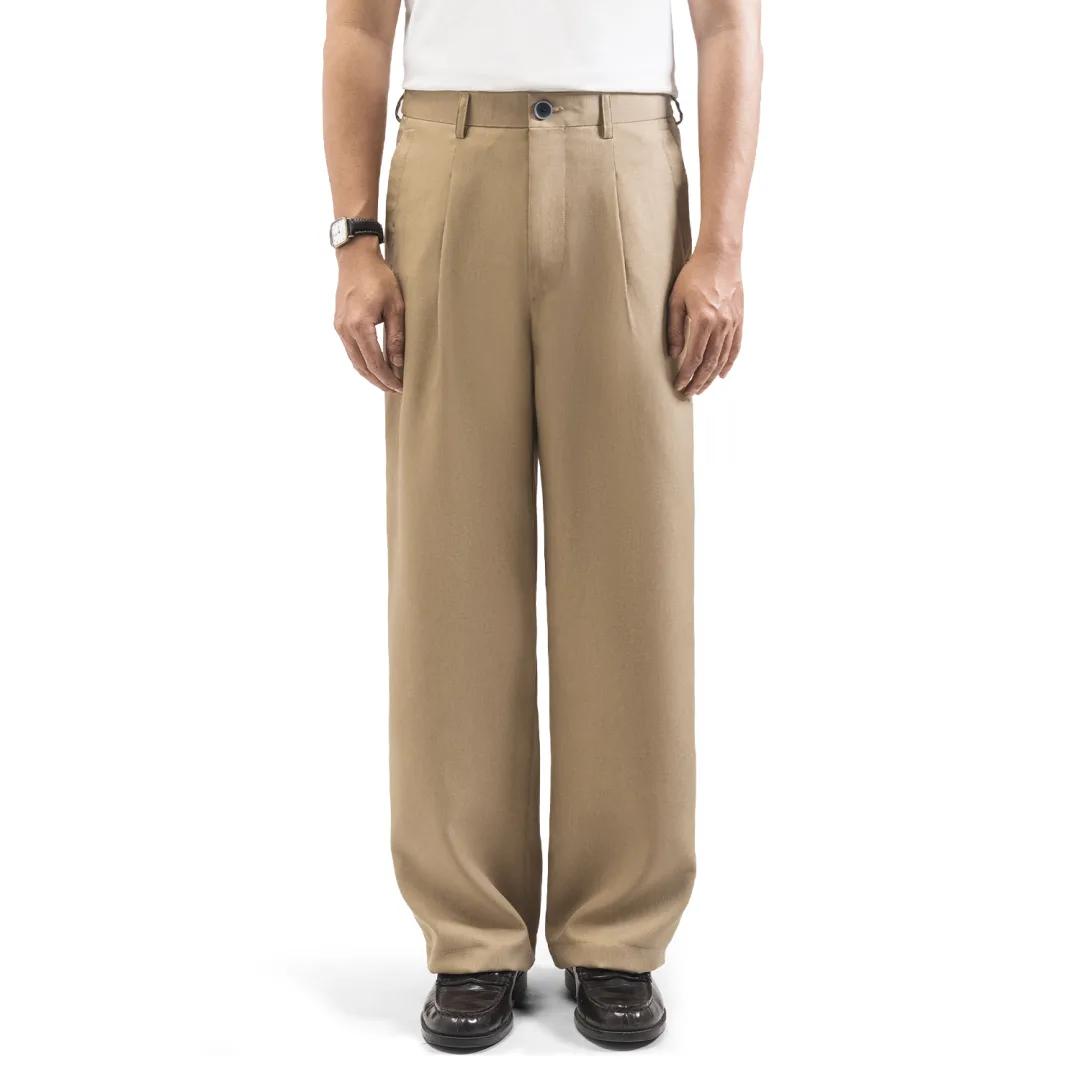
For those who prefer a looser cut, pants with pleats at the front can be an alternative. Pleats give a polished impression along with extra room to move, like these wide-cut pleated pants. One is enough. A second pair of dressy pants will only turn into a just-in-case item.
Three Tops Are Enough, as Long as They Cross Over to Both Bottoms
The simple rule goes like this. Every top that goes into the suitcase must work with both pairs of pants. If it only works with one of them, it falls into the overlap category and should stay home.
With that rule, three tops are enough. One is worn on departure day, two go into the suitcase. Two pairs of pants and three tops can be mixed into six different looks, yet the bag feels light. Choose neutral colors so no pairing looks off, and stop there.
Shoes and Small Items That Fill the Suitcase Back Up
If the suitcase is still cramped after two pairs of pants and three tops, the suspect is usually shoes. Shoes are the most space-hungry items in any bag. Limit yourself to two pairs: one on your feet from the moment you leave, one spare only if there's an occasion that truly needs it. There's no such thing as just-in-case shoes.
The rest is small items, and this is where a suitcase often leaks without you noticing. Before anything goes into the bag, gather everything on the bed first. Underwear, socks, a belt, all laid out in a row. On the bed, the quantities are visible, and any excessive pile gets caught before it has a chance to add weight.
From that pile, the rule is simple. Underwear and socks matching the number of days plus one. One belt, one that works with both pairs of pants. Done.
The Final Test Before the Zipper Closes
Before closing the suitcase, run one quick test. Point at each item, then say when it will be worn. Not "might come in handy," but which day, which occasion. If you can't answer within two seconds, take the item out.
This test feels trivial, but it separates items with a job from just-in-case items faster than any packing list.
The difference only becomes clear on the trip home. The suitcase is lighter than when you left, and all that's left inside is one bag of dirty laundry. Not a single item comes home without ever leaving the bag.