
It's Sunday night, and five pairs of sneakers sit in a row on sheets of newspaper out on the porch. You've just finished scrubbing their soles one by one with an old toothbrush. While they dry, you start working out what to wear each day next week. The plan stalls at the second pair.
The chunky pair only looks right with wide jeans. The slim canvas pair disappears under those same jeans, so it needs something narrower. The retro runners in a loud colourway call for dark pants. The shoes are sorted in five minutes. The pants never are.
There's a calmer way to put together sneaker outfits: reverse the order. Settle on one cut of pants in a quiet colour first, then let the shoes take turns. Because the cut hardly ever changes, each pair's character actually becomes easier to see.
The Same Cut Lets Each Pair Show Its Character
Look at how online sneaker stores photograph their stock. Every pair is shot against the same plain background, from the same angle. Because the backdrop never changes, your eye goes straight to the details that matter: how thick the sole is and how the colours play off each other.
Pants that never change shape work like that backdrop. Under the same pants, retro runners look slim and low to the ground, while basketball shoes look sturdy. You can also judge honestly which pairs don't really suit your style, because you can no longer blame the pants.
If the pants change every time the shoes do, what you're really judging is the pants and shoes together. You're never quite sure what made that day's look feel right: the shoes or the pants.
Match the Leg Width to Most of the Sneakers on Your Rack
No single cut will be perfect with every shoe. Pick the one that works with most of your collection. The rule of thumb is simple: the width of the leg opening should balance the bulk of the shoe.
A very wide leg swallows a slim canvas shoe. Flip it around, and chunky soles under narrow pants look like a pair of boats.
So start by counting what's on your rack. If most of it is low and slim, like canvas shoes or plain white leather sneakers, go for a straight leg of medium width. Chinos, cotton pants with a fine diagonal weave, are among the easiest choices. Black chinos with a straight leg, for example, drop cleanly to the top of the shoe without swallowing it.
If your rack is mostly chunky soles or big basketball shoes, a wide leg is better balanced. The wide-leg raw denim from the Elite Wide line is one example. Raw denim is denim that hasn't been washed since it was dyed. The fabric is stiff when new and hangs in a firm, clean line, so the wide shape holds over a big shoe.
Got a mixed collection? A straight leg of medium width is the safest middle ground. Slim shoes don't get lost, and chunky ones don't look oversized.
Pant Length With Sneakers: The Hem Meets the Shoe Without Hiding the Sole
For a collector, the sole and the sides are the parts of a shoe most worth showing off. They're also the parts you scrub with a toothbrush every Sunday night. A hem that stacks up on top of the shoe hides all of it.
A safe rule: the hem should just touch the tongue of the shoe, with no more than one small break. From the side, the toe and the sole should still show in full.
Because the cut is now fixed, you only need to set the length once. When you go to the tailor, bring two pairs with you: the biggest and the slimmest you own. Try them on in turn, then find the hem length that still looks good with both.
A note for owners of white sneakers or light canvas pairs. The indigo in new raw denim can rub off onto the parts of the shoe that the hem keeps brushing, especially when it's damp. A hem that doesn't stack up on the tongue also means less rubbing.
Choose Pant Colours That Let Your Sneakers Lead
The cut is what stays fixed. You can own it in more than one colour, as long as they're all quiet. Black, charcoal and navy all make brightly coloured shoes stand out even more. These colours also get along with almost any top, from a plain tee to a button-up shirt, so a change of shoes doesn't mean a change of top.
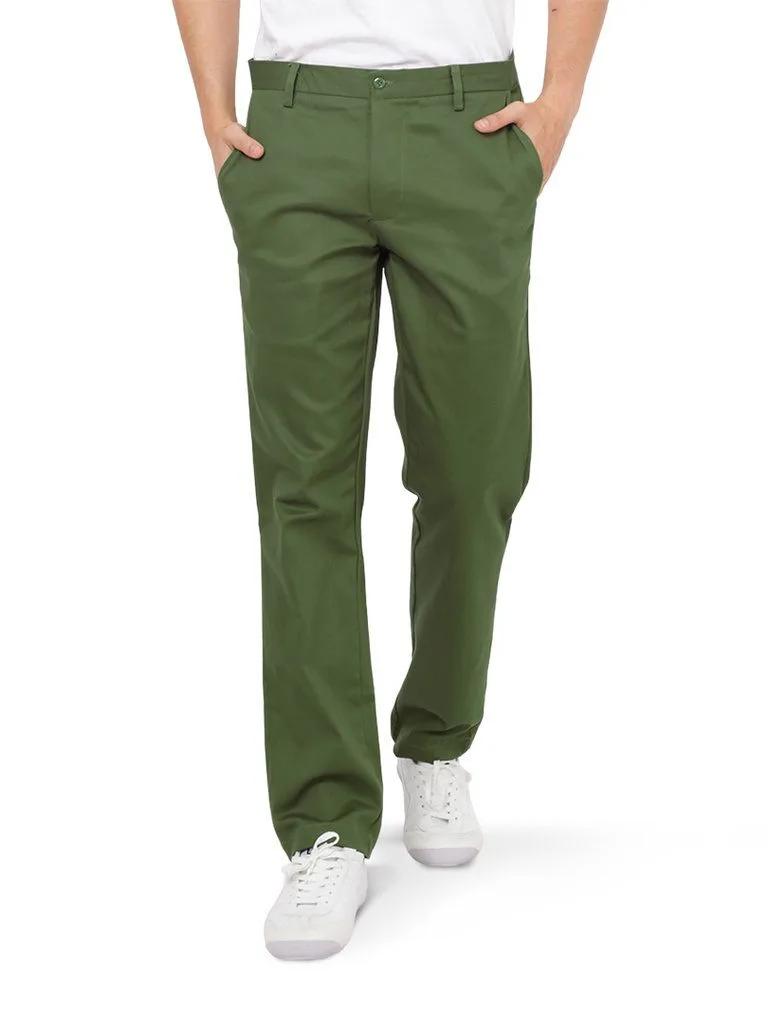
If your rack is mostly white and grey shoes, earth-toned pants can give your outfits more life. Olive green chinos, or a coffee brown pair, still read as neutral, and white shoes look even brighter beneath them.
Watch out, too, for pants that are too close in colour to the shoes. Cream pants over cream sneakers erase the line between the two, and from a distance the shoe loses its shape as well.
Test Your Chosen Pants With Every Pair on the Rack
Before you commit, try it out at home. Put on the pants you've chosen, then try your shoes one pair at a time. Photograph your legs from the knee down in the same spot and the same light, then line the shots up in your phone's gallery. Any pair that looks off will give itself away immediately.
If only one or two pairs look wrong, you've got the right pants. Those pairs just need a rule of their own. High-tops that cover the ankle, for instance, look neater with the hem rolled once so it stops just above the shoe. A very big shoe is allowed its own pair of wide pants.
If half the rack looks wrong, it's the cut that doesn't suit your collection yet. Go back to the question of leg width, then try a slimmer or wider cut.
Next Sunday night, you only need to plan the shoes.