
The ten o'clock meeting. You've ended up with the seat directly under the air-con vent, and without realising it you've crossed your arms over your chest. Anyone watching might think you're listening intently. The truth is you're cold. An hour earlier you were still on the station platform, wiping sweat from your temples.
Nearly every workday follows the same pattern, and so far nothing in your wardrobe feels at home in both places.
Why One Outfit Struggles with a Hot Commute and a Cold Office
The heat on the street is bearable. So is the cold in the office. The hard part is the switch between them. As soon as the building's glass doors close behind you, the air is completely different.
Clothes that suit the meeting room feel too heavy on the pavement. Clothes that feel good on the pavement give you goosebumps under the air-con. So split the job. Your main outfit takes care of the heat on the way in, and one light layer takes care of the cold indoors.
The Most Practical Extra Layer: A Thin Knit Sweater
This layer has just one requirement. Once it comes off, it has to fold up small and go into your bag without crowding out your laptop or your water bottle. A thin knit sweater fits that role best. If you'd rather not mess up your shirt collar every time you pull the sweater over your head, a thin knit cardigan can take its place.
A thick jacket usually meets a different fate. It sets off with you in the morning, then sits draped over the back of your chair until it's time to go home.
A Shirt That Still Looks Sharp When the Sweater Comes Off
The sweater is only a guest. It turns up when the air-con starts to bite, then leaves again when you head downstairs for lunch. What people see from morning to late afternoon is your shirt, so this is the piece to choose with the most care.
As a rule, the shirt has to look complete even when it's worn on its own. A navy oxford shirt with a collar that holds its shape is a good example. Wear it by itself or under a sweater and the look still holds together.
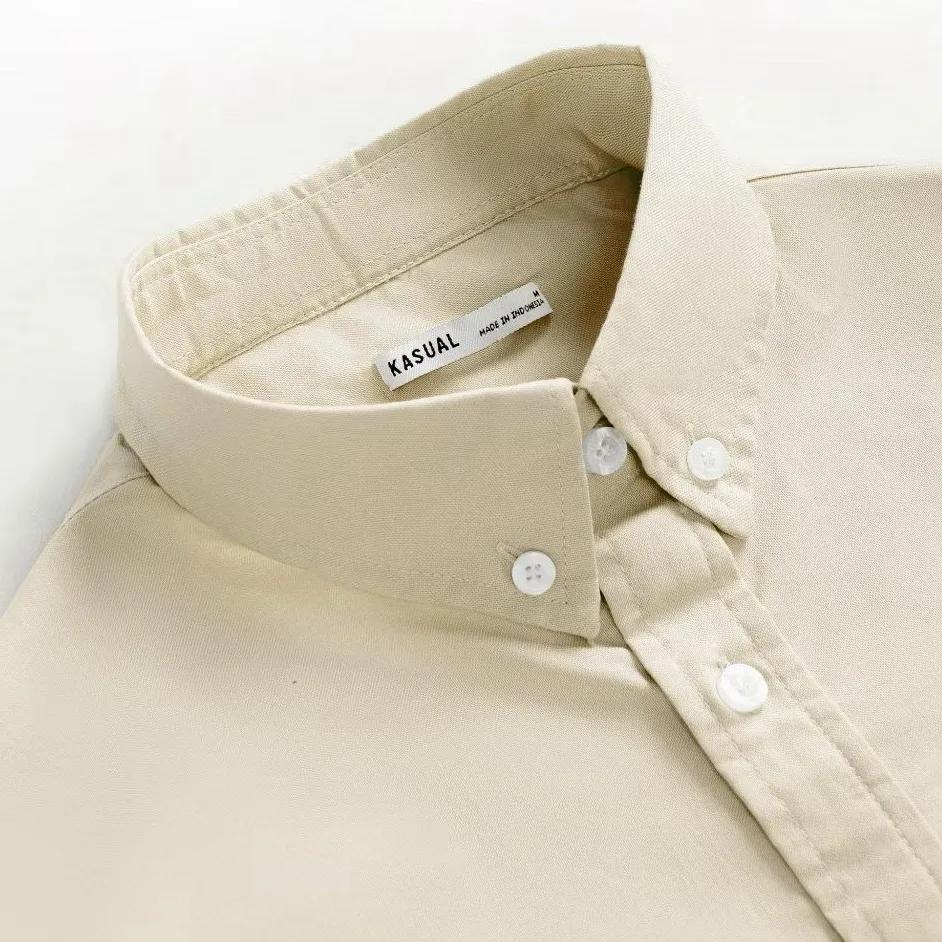
For a commute under a blazing sun, light colours help because they don't absorb as much heat as dark ones. A cream oxford shirt is comfortable on mornings like that. If your office has a more formal feel, a black shirt in a fine, smooth fabric is a better match. Neither feels like anything is missing, even with no layer on top.
The Mirror Test Before You Leave: With and Without the Sweater
Before you leave the house, stand in front of the mirror with the sweater on. Take it off, then look again. Both versions need to be fit for the meeting room.
If either one feels half-finished, replace the piece responsible. More often than not, that's the shirt, not the sweater.
If both pass, fold the sweater into your bag. Later, in the meeting room, that sweater will keep the cold at bay, and your hands will be free to take notes again.
Frequently Asked Questions
Isn't a sweater too warm to take to the office when it's scorching outside?
No, because a thin knit sweater only goes on once you're inside an air-conditioned room. On the way there, it can stay folded in your bag.
Is an oxford shirt good for commuting to work in hot weather?
Yes. The fabric is cool enough for the journey, as long as you don't throw a heavy layer over it before you leave home. That way the collar is still crisp when you arrive at the office.
Is a jacket or a sweater better for a cold air-conditioned office?
A thin knit sweater is more practical because it folds down small without creasing. A jacket is usually too heavy when all it has to do is keep out the chill of the air-con.
Why does a shirt sometimes look sloppy once the sweater comes off?
Usually the collar is limp or the cut is too loose, and the sweater was covering it up the whole time. A shirt with a collar that holds its shape and a cut that fits your body doesn't have that problem.
What sweater colour is easiest to pair with office shirts?
Navy, dark grey or black. These neutrals go with almost any shirt and still look understated draped over a chair. With a cream oxford shirt or a black shirt, navy and dark grey are the safest choices.
Can you still wear a long-sleeved shirt on a hot day?
Yes. Roll the sleeves up to just below the elbow for the commute, then roll them back down as soon as you walk into the chilly office.