
The One-Button Test: How to Tell If a Shirt Collar Will Collapse Before You Buy
Published
The photo from the team dinner lands in the WhatsApp group not long after you get home. You zoom in to find your own face, but the first thing you notice is your collar. The left side has flopped flat against your chest. The right side has curled inward and tucked itself under the front of the shirt.
Yet in the mirror this morning, the shirt looked sharp. The difference comes down to one button. In the morning every button was done up. By late afternoon you had undone the top one, the moment your last meeting wrapped up.
Almost every shirt gets judged fully buttoned, whether in a fitting room or in a tidy product photo. Once you've bought it, the same shirt is worn for months with the top button open. Its collar was never tested the way you actually wear it.
The Top Button Can Hide a Floppy Collar
The top button is like a hand holding the collar in place. As long as that hand is there, even the weakest collar looks upright. Only when the button comes undone do you find out whether the collar can stand without being held.
A strong collar is easy to spot. A small V opens up just below your neck, and both sides of the collar still rise slightly towards your jaw. No part of it lies flat against your chest. Your face keeps its frame, next group photo included.
In a laid-back office or out with friends on the weekend, hardly anyone buttons a shirt all the way to the neck. Doing up every button is usually saved for a tie and formal occasions. So the rule is simple. If the collar stays up after one button is undone, the shirt is worth considering. If it collapses straight away, even a great colour won't do much to help.
What Keeps a Shirt Collar Up Without a Tie
A collar's strength comes from something you can't see: the interlining between its two layers of fabric. That layer is the collar's backbone. If it's thin, the collar feels limp when you pinch it, and after a few washes the points start to curl and won't lie straight again.
Height counts too. A slightly taller collar has more surface to rest against your neck, so it's less likely to topple when the button is open.
The shirt fabric plays a part as well. Oxford, a cotton cloth with a slightly textured weave, tends to hold its shape when it has enough weight. Very thin fabric goes limp right along with the collar.
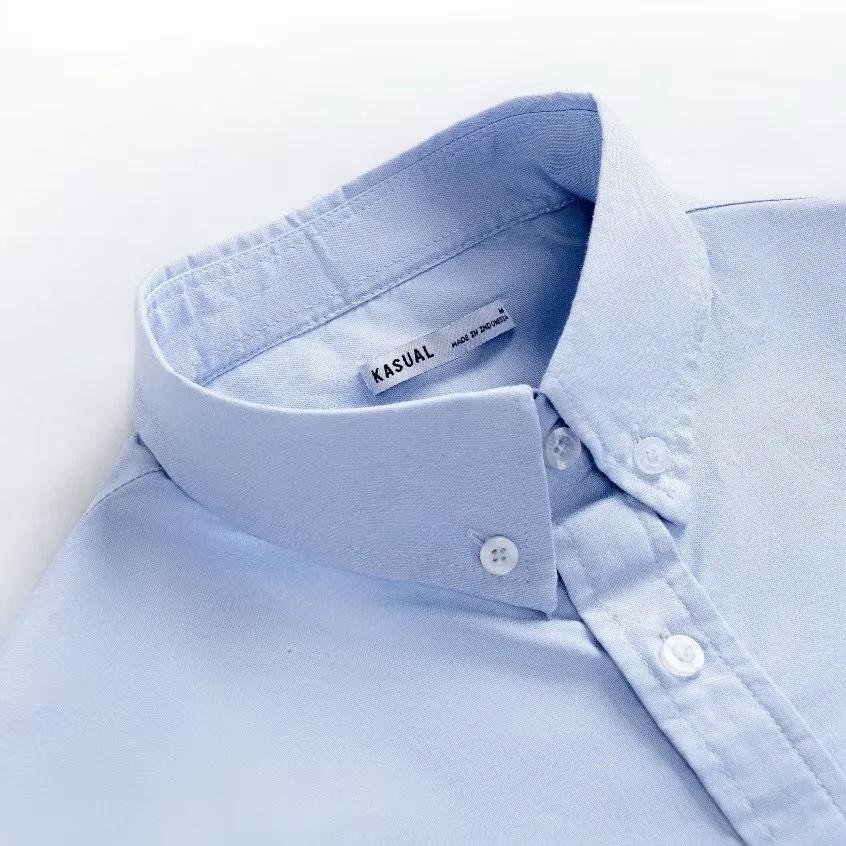
For an example, look at the light blue Basic Oxford shirt. It's made from mid-weight oxford cotton, thick enough to hold its shape. The collar is a button-down: each point fastens to the body of the shirt with a small button. Those buttons keep the points where they belong, so the collar doesn't splay open easily when the top button is undone.
Not Every Wide-Open Collar Is a Weak One
Some collars are made to fall open, so don't be quick to call them weak. The Cuban collar is one example. It usually has no top button and is sewn from the start to lie down, opening into a wide V.
Neatness is how you tell them apart. Both sides of a Cuban collar lie down in the same shape, like mirror images. A weak collar collapses any which way, with one side sitting lower than the other, just as it did in that group photo.
If you'd rather not deal with any of this, choose a collar that has no fold to begin with. The black Ammar koko shirt, for example, has a mandarin collar, a short band that stands upright around the neck. Top button open or done up, there's nothing there that can fall flat.
How to Do the One-Button Test in Store
Start with every button done up, including the very top one. Check the neck size first: it should fit snugly without choking you. A collar that's too loose has no neck to lean against, so the test result can't be trusted. If the collar is a button-down, make sure the two small buttons at its points are fastened too, since that's how it's meant to be worn.
Next, undo the top button and stand still in front of the mirror for a moment. See whether both sides of the collar stay up in a small V, or slowly slide down onto your chest.
While you're still at the mirror, pinch the collar between your thumb and forefinger. You'll feel whether there's enough interlining inside, or just two layers of fabric. Finally, bend a collar point slightly with your finger and let go. A healthy collar springs straight back. A weak one returns slowly, or seems quite content to stay bent.
Reading the Collar in Product Photos, Then Testing It When the Parcel Arrives
Shopping online doesn't let you pinch a collar, so lean on the photos. A shirt on a hanger or folded flat says little about its collar. What you're after is a photo of a model wearing it with the top button open. In that shot, look at how high the collar sits against the neck, then read the fabric description. If it's a fairly heavy oxford, the collar usually has a better chance of staying up.
The real test has to wait until the parcel turns up. Say the cream oxford shirt you ordered has just arrived. Try it on in front of the mirror straight away, then undo the top button before you snip off the tags. Don't wait until it's been through the washing machine. A collar that collapses while the shirt is new won't get any better after a wash.
If an Older Shirt's Collar Has Already Collapsed
For shirts that have been in your wardrobe a while, the options are fewer, but there are some. Starch can make a collar look fresh again, though only until the next wash. Interlining that has gone soft or set into a crease won't recover just because you iron it. A shirt like that is safer worn fully buttoned, or under a crew-neck sweater that helps prop the collar up.
A shirt whose collar still stands up only needs gentle washing, without wringing the collar. Treated that way, good interlining can last for years. If the collar points on a shirt you bought recently are already curling and feel flimsy when you pinch them, that's a sign the interlining is starting to give up.