
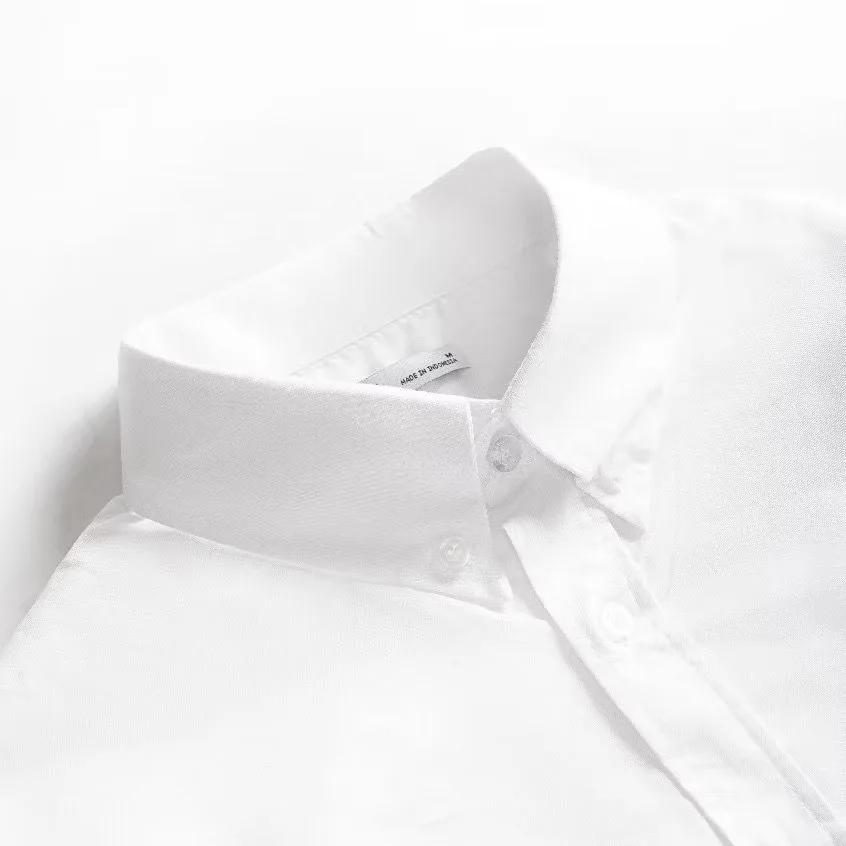
The parcel arrives late in the afternoon, and you try the shirt on straight away in front of the wardrobe mirror. The colour is exactly what you saw in the photos. The size is the one you ordered. But something looks off, and it takes a few seconds to work out why: the shoulder seams are sitting on your upper arms. Your new shirt suddenly looks like a hand-me-down from an older brother.
It nearly always comes down to one of two things. Either the type of shirt doesn't suit what you need it for, or the size is wrong at the point that matters most, the shoulders. Both can be avoided from the start, as long as you know what to look for.
The Oxford Shirt Takes You From Office to Weekend
Oxford cloth has a slight texture when you run your fingers over it. It isn't smooth or shiny, so the shirt looks tidy without seeming stiff.
That texture is what lets an oxford shirt move so easily between settings. On a Monday morning, tuck it into tailored trousers and put on a belt. It's immediately smart enough for a meeting. On a Saturday afternoon, leave it untucked and roll the sleeves up twice. The same shirt now feels relaxed enough for coffee or a wander round the mall.
If your wardrobe only had room for one shirt, make it an oxford.
A Striped Shirt Needs Plain Trousers
A striped shirt, which online shops often list as a stripe shirt, already makes a statement of its own. The stripes catch the eye without any help. So whatever you pair with it should stay quiet: plain trousers and plain shoes.
Trouble starts when stripes meet another pattern. Put a striped shirt with checked trousers, or with patterned shoes, and people's eyes can't decide where to settle. One standout is plenty, and on this shirt the stripes have already claimed that job.
Stripe width is a useful clue as well. Thin, closely spaced stripes look almost plain from a distance, so they are easier to wear to the office. Wide stripes with more space between them are better saved for days off.
The Cuban Collar Shirt Is Made to Be Worn Untucked
A cuban shirt is easiest to recognise by its collar. It sits open and lies flat against the chest, rather than standing up around the neck like the collar on an office shirt. The cut is looser. The hem is usually straight, because the shirt is designed to be worn outside your trousers.
Cuban shirts are made for hot weather and easy-going occasions, such as a beach holiday or a late-afternoon catch-up at a friend's place. The temptation to tuck one in usually comes when you want to look neater. The result is anything but neat. All that roomy fabric has nowhere to go, so it balloons out around your waist.
If the occasion calls for a tucked-in shirt, what you actually need is an oxford.
Baju Koko, the Easy Way to Look Respectful
A koko has a straight, modest cut, so it looks respectful without you having to add a thing. That's why the baju koko is the go-to for Friday prayers, iftar gatherings and Eid. It works beyond those moments too, say on a visit to your in-laws.
Each colour has its place. The short-sleeved white koko is the easiest to pair with any trousers in your wardrobe. The cream version is a more understated pick for daytime events. For evening occasions, the black one is the safest choice.
A Good Shirt Fit Starts at the Shoulder Seam
When you try on a shirt, hold off on checking the chest or the sleeve length. Look at the shoulders first. The seam that joins the sleeve to the body of the shirt should sit right at the end of your shoulder, where it starts to curve down into your arm.
If that seam slips down onto your upper arm, the shirt is too big, whatever the label says. If it rides up onto the top of your shoulder and the sleeves pull when you move, the shirt is too small.
The shoulders come first because they are the hardest part to save. A slightly loose chest is still comfortable to wear all day. Sleeves that are too long can be shortened by an alterations tailor. The shoulders are another story. Fixing them means taking apart almost the entire shirt, and the cost is rarely worth it. However much a shirt costs, it will still look like the wrong size if the shoulders are off.
Sizing Up Actually Makes a Shirt Look Too Big
The most common mistake comes from a good place: going up a size to get a little more room. In your head, the reasoning makes sense. In the mirror, the shoulder seams drop straight onto your arms and the sleeves widen along with them. The shirt looks borrowed, even though you've only just bought it.
If room to move is what you're after, choose a cut that is designed to be loose from the start, such as a cuban shirt. Your size stays the same. Only the shape is made roomier. The name of the cut is usually shown on the product page. If terms like slim or straight still confuse you, you can read what they mean in the KASUAL Help Centre.
How to Measure Shoulder Width Before You Shop Online
Shopping online doesn't give you a chance to try anything on, but a shirt from your own wardrobe can serve as your guide. Pick one whose shoulders already fit you well. Button it up, lay it face down on the bed, and smooth the fabric flat with your palms. Run a soft tape measure straight across from the left shoulder seam to the right one, then save the number in your phone's notes.
That's the number you take to the seller's size chart before you order. If shoulder width isn't listed, ask the seller directly. If your number falls between two sizes, choose the one whose shoulder width is closest to your reference shirt. A small gap in the chest or sleeves can still be sorted out, but a gap at the shoulders almost never can.
The next time a shirt is tempting you from your shopping cart, open that note before anything else. Match the shoulders first, then the colour.