
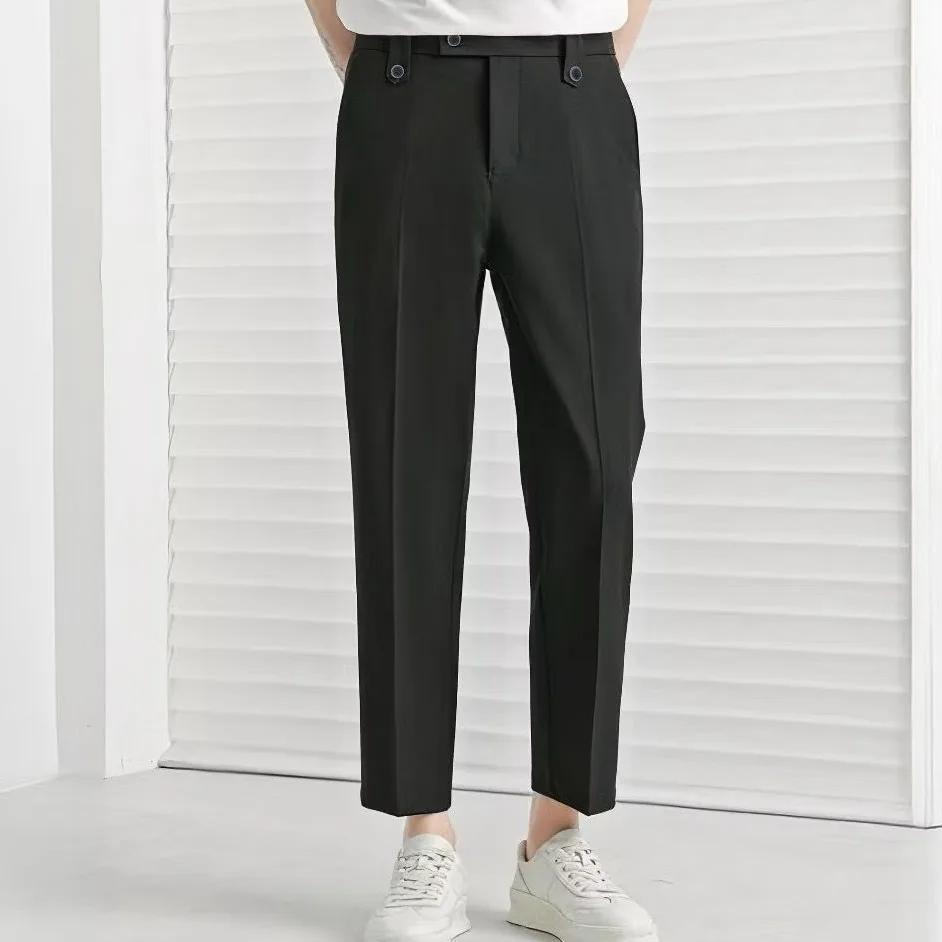
Men's dress pants that look sharp and ones that look ordinary sometimes come in the same size. The cut is similar. The color is close. But once worn, the impression is different. That difference almost always comes from the fabric surface.
You don't need to memorize fabric names to read this difference. Just pay attention to four things: sheen, texture, crease sharpness, and how the fabric falls. These four work together, and you can read them without even touching the fabric.
Sheen Gives the First Impression
Before people notice the color or the cut, the eye catches the sheen on the fabric surface. Sheen here doesn't mean glossy like satin. Dress pants that look sharp usually have a thin, even sheen.
Fabric with a thin sheen reflects light softly. The result is a surface that looks clean and not dull. If the fabric surface looks very matte and flat, the pants tend to read casual. If it's too shiny, the impression leans toward costume.
The easiest way to check: look at the pants under store lighting or window light. Notice whether there's a thin, evenly spread reflection. That's the sign of a sheen working in favor of a sharp look.
Texture Is Not About Smooth or Rough
Many people think the smoothest fabric must be the sharpest. Not always. Fabric that's too smooth and slick can actually show every small wrinkle. Meanwhile, a slightly textured fabric, one where you can see the weave up close, is more forgiving of everyday movement.
What matters is the regularity of the texture. Sharp fabric has a consistent weave. No part is looser or tighter than another. From a step away, the surface looks uniform.
Texture also affects how the pants catch dust and lint. Very smooth fabric shows small marks more easily. This isn't about quality, it's about how ready the fabric is for daily activity.
A Center Crease That Holds
Formal dress pants usually have a center crease down the front of the leg. This crease isn't decoration. Its job is to create a vertical line that makes the leg look longer and more put together.
But not all creases are equal. Some hold all day, others disappear after half an hour of sitting. Fabric that can hold a crease tends to be firmer. Not stiff like cardboard, but firm enough not to soften right away.
How to check: press the center crease lightly with two fingers, then release. If the crease line springs back sharp, the fabric can hold its shape longer. If it blurs immediately, the crease will fade quickly once worn.
Not all dress pants need a center crease. Pants like the Ankle Prime, which has a more casual cut, are usually designed without one. The sharp impression comes from other things: the drape and the cleanliness of the silhouette.
Drape Shows When You Stand Still
Drape is how fabric responds to gravity. Fabric with good drape follows the body's shape without clinging. The result is pants that look clean from the side. No odd bulges, no fabric ballooning at the thigh or knee.
Fabric that's too stiff makes the pants look like they stand on their own, separate from the body. Fabric that's too limp clings and reveals the leg's shape in too much detail. A sharp look sits in the middle: fabric that follows without clinging.
How to check in a store: stand normally in front of a mirror. Look at the thigh and knee area. If the fabric falls straight without pulling sideways, the drape is working. If there are horizontal folds across the thigh, the size is likely too tight or the fabric too stiff for that cut.
The Executive Ankle Pant is an example of dress pants that rely on drape for their sharp look. Without a center crease, the clean silhouette comes from how the fabric responds to movement.
Read All Four as One
Sheen, texture, crease, and drape are not a separate checklist. The four work as one system. Pants with a thin sheen, regular texture, a lasting crease, and clean drape will look sharp even after a full day of wear.
But you don't always need all four elements at once. Formal pants with a center crease rely on sheen and crease sharpness. Sharp casual pants like the Smart Waist Ankle Prime rely on texture and drape. What matters is that the elements present work together, not against each other.
If you're standing in front of a rack of dress pants and can't decide, start with one question: what situation are these pants for? Formal situations call for sheen and crease. Sharp casual situations call for texture and drape. That answer narrows your options faster than memorizing fabric names.
One Move in the Fitting Room
Before deciding, do one thing in the fitting room. Stand, sit, then stand again. Look at what happens to the fabric surface after you stand back up. Does the fabric smooth out again? If there's a crease, is it still visible? Are there no new wrinkles that stay set?
Good dress pants return to their shape within seconds. A surface that can recover itself after the pressure of sitting is the sign of fabric that keeps a sharp look all day.
Pick the one whose fabric surface works for you, not the one whose name sounds the most luxurious.