
Twenty minutes into the film, the nasi goreng you polished off before heading in starts to make itself felt. You shift in your seat, sit up straight, then shift again. The waistband that has felt perfectly fine since late afternoon is now pressing in just below your navel.
The moment the film ends and the lights come up, you stand up. The pressure disappears without a trace.
Your trousers didn't change in the slightest while the film was playing. Your waist did, and it does so almost every day, whether you're in an office chair or on a motorbike heading home. This small, daily nuisance is exactly what an adjustable waistband is for. It's genuinely useful, as long as you understand its limits.
Why Trousers Feel Tight When You Sit and After You Eat
You usually put your trousers on in the morning, standing at the wardrobe on a mostly empty stomach. The fit you feel at that hour is real, but it's the fit of your waist at its slimmest.
Sitting down is a different story. Your stomach folds forward and spreads out to the sides, while the waistband stays at its morning size. After lunch and two hours of staring at a screen, the pressure on your stomach is hard to ignore. At the end of the day, once you're up from your chair and walking to the lift, the same trousers suddenly feel roomy again. Tomorrow, the cycle starts over.
The difference is only a few centimetres. It just happens to sit at the waistband, the one part that keeps your trousers where they belong.
A Regular Waistband Fits You Standing or Sitting, Not Both
A regular waistband is a fixed size. So when you buy a pair, you're deciding, without realising it, which version of your waist it should fit: the morning one or the late-afternoon one.
Choose a pair that fits when you're standing, and you have to put up with the squeeze every time you sit for long. Choose one that's roomy when you're sitting, and they slip down easily as you walk. So the belt gets pulled tighter to hold them up, and the fabric around your waist bunches up with it.
Both options are compromises, and most men live with one of them every day without ever stopping to question it.
Only a Few Centimetres of Give, and That's Enough
When a product listing mentions an adjustable waistband, it simply means the waistband has been given a little room to expand and contract. There isn't much room, just a few centimetres either side of the original size. So don't expect one pair of trousers to fit two different body sizes.
The good news is that a little room is all you need. It's roughly the difference between your waist in the morning and your waist after lunch at your desk. You no longer have to choose between comfort standing up and comfort sitting down, because the waistband adjusts with you.
You Still Need the Right Size From Day One
Because there's so little room, the size you choose still has to be right from the start. An adjustable waistband takes care of the daily ups and downs. Picking the right size is still the size chart's job.
If you deliberately buy a size up, hoping the elastic or the straps will take up the slack, the result won't look as neat as trousers that genuinely fit. The same goes for your weight. A small gain or loss can still be absorbed. If the change is bigger than that, it's time for a different size.
Choose the size the same way you would for any pair of trousers. Use the old pair that has always fitted you best as your benchmark, measure it, then check the numbers against the size chart.
Two Kinds of Adjustable Waistband: Hidden Elastic and Gurkha Straps
Trousers with this feature generally work in one of two ways. The first uses elastic tucked behind the waistband fabric. From the front, they look just like ordinary office trousers once they're on, button and zip included. The elastic stretches as you sit and pulls back in as you stand, and you don't have to touch a thing.
This is how the Smart Waist line works. Take the dark grey Smart Waist, which is polished enough to wear to a meeting at the office. On trousers like these, a belt is purely a matter of taste, because the elastic already holds them up on its own.
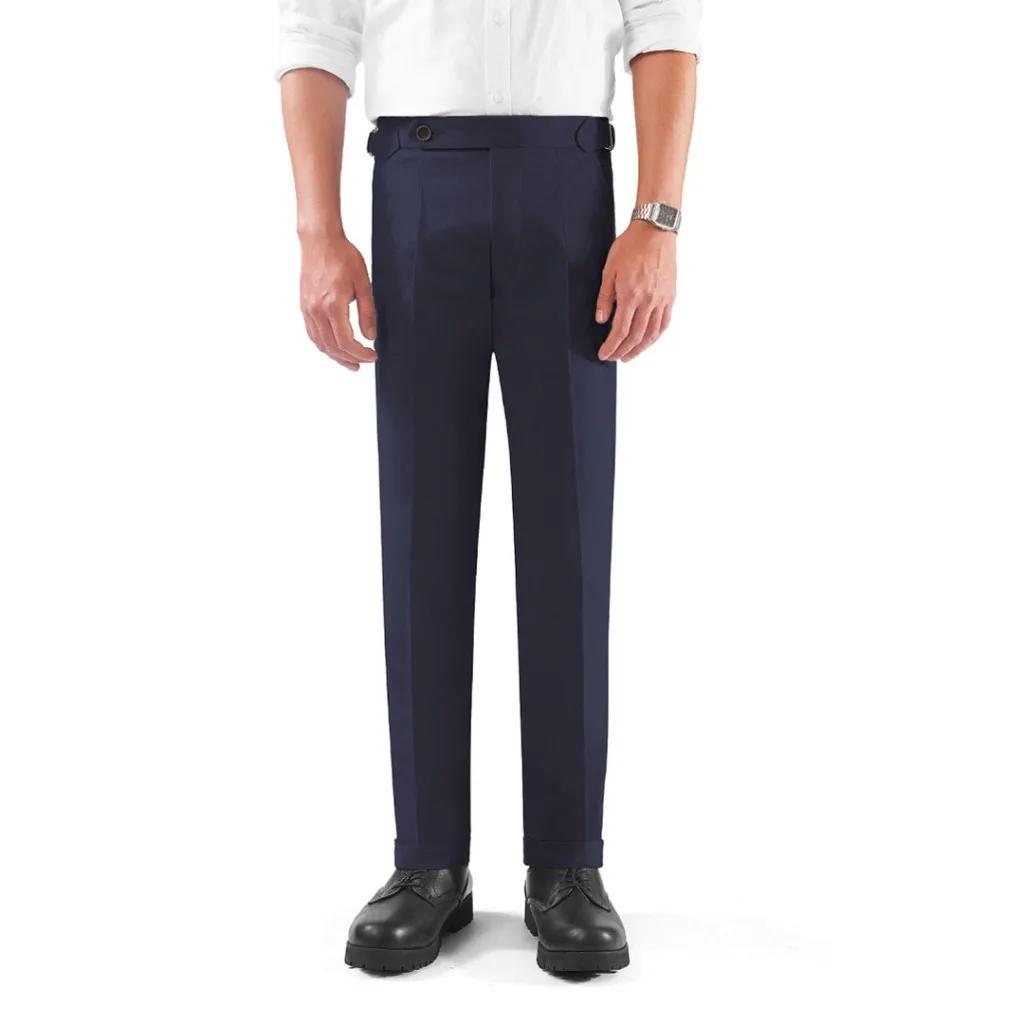
The second approach uses small buckled straps on both sides of the waist. This is the signature of gurkha trousers, a style that does without a belt because the straps on the left and right do the job of tightening the waist. Set them to the right fit once and you can leave them be. You'll only need to shift them a little now and then, say after a big meal at a family gathering. On the cream gurkha trousers, the front stays clean with no belt buckle, so the waistline looks neat.
Who Gets the Most Out of an Adjustable Waistband
You'll feel the benefit most if you spend a lot of time sitting, whether at the office or on a long commute home. The same goes if your weight tends to drift up and down a little, or if you simply can't be bothered with belts. If your current trousers rarely feel tight, there's no reason to rush out and replace them all.
To choose between the two, look at how you get dressed each day. If your mornings are always rushed and you want trousers that are good to go the moment you button them, go for hidden elastic. If you like small details such as adjusting straps, and prefer a clean waist with no belt, gurkha trousers will be more satisfying. Both types also come in lighter colours, such as the cream Smart Waist or the cream gurkha mentioned above.
If you're still unsure, spend the next week noticing how often you quietly loosen your trousers after sitting for a long time, at the office or at the cinema. If it's almost every day, you'll feel the difference straight away. If it hardly ever happens, the trousers you already own are fine as they are.